Brand Architecture
"The complete visual identity system for Babylon Born — colors drawn from ancient Mesopotamia, typefaces rooted in inscription tradition, and the mark and its meaning."
Foundation
Our Vision — A collectively conscious world, awakened to the full capacities of the human spirit.
Our Mission — To embody authenticity — documenting and preserving lived truth in record.
Our Promise — Babylon Born expands human awareness through art, music, and storytelling.
Our Essence — Witness. Illuminate. Awaken.
Our Values — Consciousness · Presence · Authenticity · Truth · Integrity · Courage · Freedom · Reverence
Babylon Born is a structured narrative architecture — the recorded life of Benjamin Ryan Powell, symbolically pressed into permanent form. It is instructed through the thesis that we are spiritual beings born into material systems that condition and suppress the memory of what we are. This platform is the record of one who went all the way inside those systems and came out still remembering.
The form of this record matters as much as its content. Babylon Born is structured, disciplined, measured, architectonic — carrying precisely what Babylon was built to suppress.
The Mark
Around 3200 BCE, scribes in southern Mesopotamia began pressing marks into wet clay with a triangular reed stylus. The wedge-shaped impressions left by that reed gave the script its modern name: cuneiform, from the Latin cuneus, wedge. It is one of the earliest writing systems. In its earliest form each sign stood for a thing or a concept. Over centuries it became capable of encoding the full range of human language — administrative records and cosmological texts, legal codes and private correspondence, the myths of gods and the accounts of ordinary men, all pressed into the same clay with the same instrument.
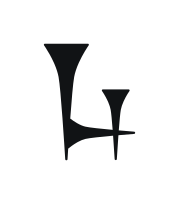
The Babylon Born mark is composed of four of these signs. Read, recognized, and assembled because of what they say.
𒈨 Me — Divine ordinances. In Sumerian cosmology the Me were the structuring powers of civilization — the underlying order beneath institutions.
𒀸 Aš — One. A mark associated with singularity — the originating point from which enumeration proceeds.
𒁹 Diš — The individual. The sign placed before a personal name in the record — this one, specified and accounted for.
𒁇 Bar — Outside. Exterior. The boundary between what is contained and what lies beyond.
Read in sequence — the mark states: a singular, named individual aligned with divine order, standing at the boundary.
A fifth sign extends this language into the interface. The navigation icon — three horizontal wedges stacked — is 𒀼 Aš×3: three iterations of the first mark. Structured multiplicity. A living system in motion. Where the logo mark states the law of the individual, this symbol expresses movement through the system. Foundational principles, impressed into a medium, create structure through defined limits. From structure arises a navigable system.

The Palette
Color in a brand, consciously or not, stirs emotions and creates a relationship worth noting. The colors here were drawn from the material record of ancient Mesopotamia — chosen first for historical accuracy, for what they carried, for what they meant to the people who used them. Then adjusted for feeling. What each color does when you look at it. What it asks of you.
Foundation Black — Diorite · #111315 Around 2100 BCE, Gudea of Lagash commissioned a series of statues as permanent offerings before the gods. The inscription records his material choice directly: "This statue has not been made from silver nor from lapis lazuli, nor from copper nor from lead, nor yet from bronze; it is made of diorite. May it endure forever." The endurance is explicit. Diorite is the structural ground of this system — the deepest surface, the color that holds everything else legible.
Neutral White — Gypsum · #faf8f6 The White Temple at Uruk, built atop a ziggurat platform around 3500 BCE, was plastered entirely in white gypsum inside and out. It would have been visible reflecting light from beyond the city walls. This white surface marked elevation — something set apart, visible from a distance, calling you toward it before you understood why. In this system Gypsum carries that same pull. The surface that holds the light. The interior you have always been moving toward.
Primary — Lapis Glaze · #247381 The Ishtar Gate of Babylon, constructed under Nebuchadnezzar II around 575 BCE, was faced in glazed brick that produced its deep blue surface. Lapis appears across Mesopotamian objects and texts as a material of distance, rarity, and association with the divine. This system does not use raw lapis lazuli. It uses a glaze — a constructed surface that carries the visual register without the material itself. A translation rather than the source. In this system Lapis Glaze is the primary color. Inviting the anticipation of something divine just ahead.
Secondary — Crimson · #c63a60 Red materials — carnelian, red limestone — appear throughout Mesopotamian objects, including the Standard of Ur (c. 2600 BCE), where red and blue form a recurring pairing across the panels. Vitality against depth. Immediacy against distance. That tension is the color — dangerous and seductive in the same breath, drawing the eye before the mind catches up. In this system Crimson is the secondary accent — the color that marks what demands to be felt.
Tertiary — Gold · #e3a500 In Mesopotamia gold was known as hurāṣu — luminous, radiant. Not merely a material but a descriptor. The visual language of something elevated, something that carries weight beyond its surface. In this system Gold marks those moments. The emphasis that shifts meaning. The threshold before decision. The thing worth pausing for.
Accent — Patina · #4e7b50 Bronze objects from the ancient Near East, when exposed over time, develop a green patina — an oxidized surface that stabilizes and preserves the material beneath. In this system Patina is the color of success. What was tested and held. What came through.
The Letterforms
Two typefaces carry this brand. Both were chosen for lineage — for what their letterforms descend from and what that descent means inside a system built on ancient record.
Trajan Sans Pro — H1 through H3 Trajan Sans Pro descends from the inscriptional lettering carved into the base of Trajan's Column in Rome, completed 113 CE. Those letterforms were cut into stone for permanence and distance — built to carry authority, built to be read from across a courtyard, built to outlast the one who commissioned them. The Romans inherited their alphabet from the Greeks, who adapted theirs from the Phoenicians, who adapted theirs from Semitic scripts emerging from the same region that produced cuneiform. The inscription tradition is a continuous line. In this system Trajan Sans Pro carries the structural register — H1 through H3, the name of the brand. The civilizational container.
Cormorant Garamond — H4 through H6 and body Cormorant Garamond is a humanist serif typeface in the tradition of Claude Garamond's Renaissance type. In its thick-to-thin stroke contrast, its bracketed serifs, its slight diagonal axis, it carries the quality of a mark made by a pointed instrument pressing into a yielding surface. The triangular reed stylus used in cuneiform produces marks with that same pressure and release — wider where the wedge enters, tapering where it lifts. Cormorant carries the witness register — H4 through H6, all body text. The human voice inside the container.
The Scale — 1.25 The type scale follows a 1.25 ratio. Each step is 25 percent larger than the one before — a proportional relationship that produces continuity across levels. The system remains coherent because every size is derived from the same source, by the same rule. Mesopotamian systems of measurement operated on base 60 for the same reason: a number divisible enough to yield clean ratios across many contexts. The investment was not in the number itself but in the principle — that proportion, consistently applied, produces order legible to anyone who knows the rule. The scale maintains that principle here. It makes the system navigable.
Babylon Born
Babylon Born
Babylon Born
a b c d e f g h i j k l m n o p q r s t u v w x y z
Babylon Born
Babylon Born
Babylon Born
The inscription begins.
Conclusion
Babylon is a pattern — a system of ordering and control that persists across eras in different forms. To be Babylon Born is to recognize that you were born inside that system, and that you see it clearly.
The name Babylon written in its own script — 𒆍 𒀭 𒊏 𒆠 — reads: gate, god, of, earth. Gate of the Gods. A threshold between the human and the divine, rendered as a place. A system named for the passage it claimed to control.
The Babylon Born mark is written in that same script. It answers from the same medium.
Not the gate. The ones standing at it. Declaring truth at the threshold to the city center.
